In this collaborative work, we examine climate change detection and attribution through a data-driven lens and using sets of large ensembles of climate model simulations. In addition to considering methods from deep learning and explainable AI, we also approach climate attribution through counterfactual simulations and storyline approaches to robustly examine extreme events while considering the important influences of internal variability from daily to multidecadal timescales. Further, we are also interested in examining how seasonal-to-decadal climate predictions can be improved and used to inform stakeholders about the probability of extreme and/or persistent temperature and precipitation events occurring on regional scales.
Summaries of selected climate attribution and extreme event studies…
Detection of future climate scenarios
A key question for regional climate services is related to which climate change scenario is most likely to evolve over the 21st century, especially when comparing climate model projections to real-world observations. Although this can already be tracked in near real-time through indices like global mean surface temperature or greenhouse gas concentrations, it remains unclear how to attribute regional patterns of climate change to different climate scenarios or to policy-relevant thresholds like 1.5°C/2.0°C of global warming.
To explore this detection and attribution topic, our new study (Labe et al. 2024, JGR-MLC) evaluates a collection of simulations conducted with the NOAA/GFDL SPEAR climate model that include different climate scenarios (natural forcing, historical forcing, SSP1-1.9, SSP2-4.5, SSP5-8.5) through the year 2100. Using this data, we then introduce a new classification method to link maps of climate variables to individual climate scenarios through a machine learning technique (i.e., artificial neural networks).
As a proof of concept, we then explore possible realizations of the future under two rapid climate mitigation pathways (also referred to as overshoot scenarios (e.g., SSP5-3.4OS)). We apply explainable artificial intelligence (XAI) methods to reveal important regions of change associated with identifying the different responses to the climate mitigation efforts. For example, we find that the North Atlantic and Central Africa are important regional indicators for the neural network to learn to distinguish between different future climate scenarios when given maps of temperature or precipitation. Our results also show that starting aggressive mitigation actions a decade earlier can lead to the lowest greenhouse gas emission scenario (SSP1-1.9) (i.e. reduced climate change impacts) being predicted by the neural network model at the end of the century.
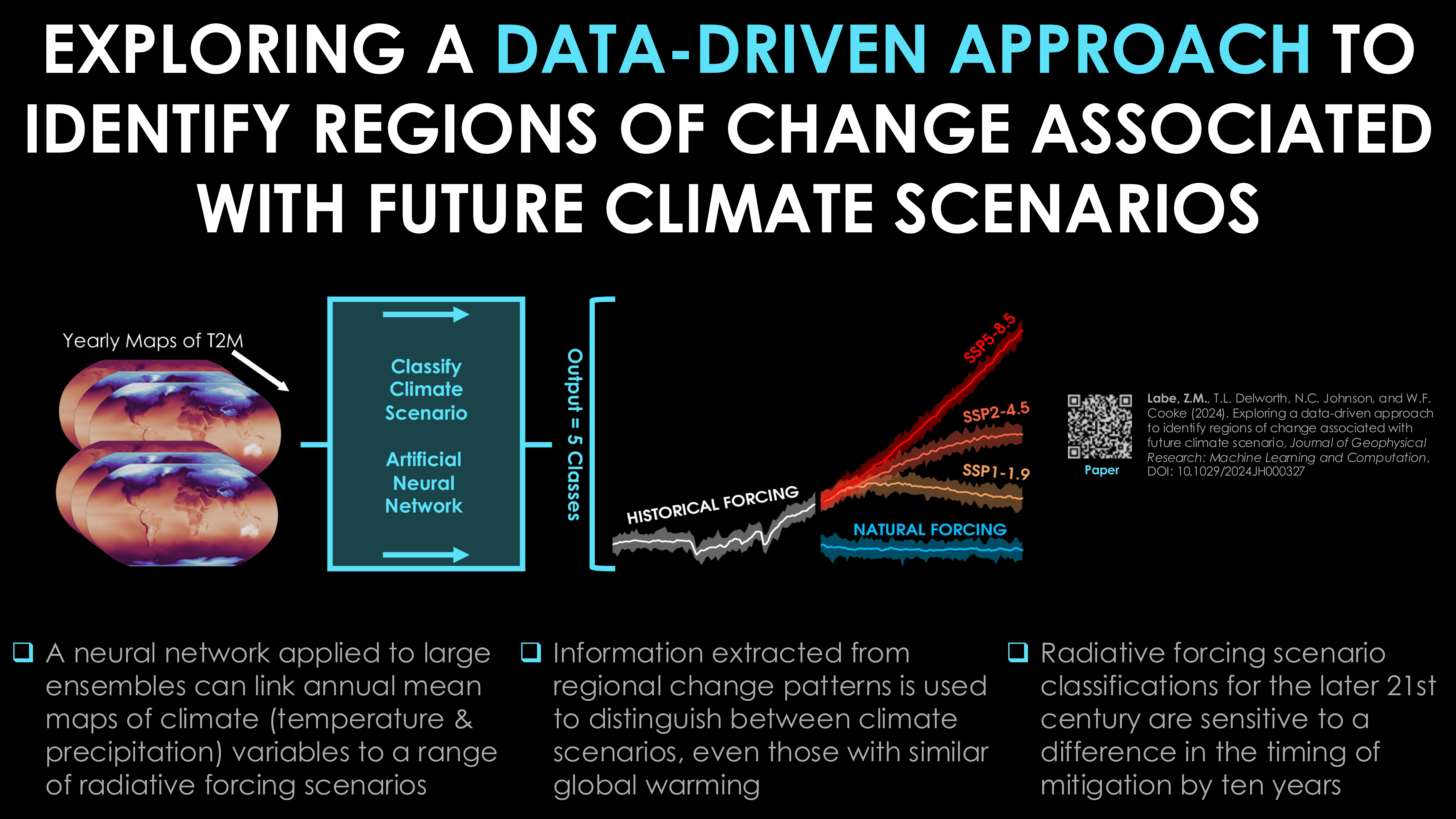
This new machine learning framework demonstrates that neural networks can learn fingerprints of regional climate change that are distinguishable across different future climate scenarios. This also suggests that a promising area of follow-up work is to consider using this data-driven methodology for monitoring observations in real-time to identify which climate change pathway the real world is actually following. Finally, the classification framework could also be used to reveal whether the impacts of climate mitigation efforts are being felt at the regional and local level for different meteorological variables. In upcoming work, we will further highlight the importance of understanding the consequences of these future overshoot scenarios for their effects on climate extremes, like heatwaves and heavy rainfall, and on the likelihood of global climate change reversibility/hysteresis.
Refereed/Peer-Reviewed:
[6] Labe, Z.M., T.L. Delworth, N.C. Johnson, and W.F. Cooke (2024). Exploring a data-driven approach to identify regions of change associated with future climate scenarios. Journal of Geophysical Research: Machine Learning and Computation, DOI:10.1029/2024JH000327
[HTML][BibTeX][Code]
Plain Language Summary
[5] Schreck III, C.M., D.R. Easterling, J.J. Barsugli, D.A. Coates, A. Hoell, N.C. Johnson, K.E. Kunkel, Z.M. Labe, J. Uehling, R.S. Vose, and X. Zhang (2024). A rapid response process for evaluating causes of extreme temperature events in the United States: the 2023 Texas/Louisiana heatwave as a prototype. Environmental Research: Climate, DOI:10.1088/2752-5295/ad8028
[HTML][BibTeX]
[Press Release]
[Climate Model Monitoring Metrics][Observational Monitoring Metrics]
[4] Kretschmer, M., A. Jézéquel, Z.M. Labe, and D. Touma (2024). A shifting climate: new paradigms and challenges for (early career) scientists in extreme weather research. Atmospheric Science Letters, DOI:10.1002/asl.1268
[HTML][BibTeX]
[3] Zhang, Y., B.M. Ayyub, J.F. Fung, and Z.M. Labe (2024). Incorporating extreme event attribution into climate change adaptation for civil infrastructure: Methods, benefits, and research needs. Resilient Cities and Structures, DOI:10.1016/j.rcns.2024.03.002
[HTML][BibTeX]
[Carbon Brief]
[2] Eischeid, J.K., M.P. Hoerling, X.-W. Quan, A. Kumar, J. Barsugli, Z.M. Labe, K.E. Kunkel, C.J. Schreck III, D.R. Easterling, T. Zhang, J. Uehling, and X. Zhang (2023). Why has the summertime central U.S. warming hole not disappeared? Journal of Climate, DOI:10.1175/JCLI-D-22-0716.1
[HTML][BibTeX]
[Fox 32 Chicago][NOAA CPO][NOAA Climate(dot)gov][Wired]
[1] Thoman, R.L., U. Bhatt, P. Bieniek, B. Brettschneider, M. Brubaker, S. Danielson, Z.M. Labe, R. Lader, W. Meier, G. Sheffield, and J. Walsh (2019): The record low Bering Sea ice extent in 2018: Context, impacts and an assessment of the role of anthropogenic climate change [in “Explaining Extreme Events of 2018 from a Climate Perspective”]. Bull. Amer. Meteor. Soc, DOI:10.1175/BAMS-D-19-0175.1
[HTML][BibTeX][Code]
[Press Release]
Submitted:
[2] Labe Z.M., T.L. Delworth, N.C. Johnson, B-T. Jong, C.E. McHugh, W.F. Cooke, and L. Jia (2025). Large reductions in United States heat extremes found in overshoot simulations with SPEAR, EarthArXiv, DOI:10.31223/X5TX4P (submitted)
[Preprint]
[1] Zhang, Y. and Z.M. Labe (2025). Adapting Infrastructure to a Changing Climate with Extreme Event Attribution Assessments. (submitted)
Presentations:
[28] Labe, Z.M. Utility of explainable machine learning for scenarios of climate change, Session III: AI Explainability and Climate Science Innovation, Broadening Access to Climate AI Innovation Workshop, University of Virginia, USA (May 2025) (Invited-Remote).
[SlideShare]
[27] Jong, B.-T., T.L. Delworth, Z.M. Labe, W.F. Cooke, and H. Murakami. Attributing changes in extreme precipitation across the Northeast U.S. under different climate scenarios , EGU General Assembly 2025, Vienna, Austria (Apr 2025).
[Abstract]
[26] Labe, Z.M., T.L. Delworth, N.C. Johnson, L. Jia, W.F. Cooke, B.-T. Jong, and C.E. McHugh. Greater reduction in U.S. heat extreme days in overshoot simulations with GFDL SPEAR, 38th Conference on Climate Variability and Change, New Orleans, LA (Jan 2025).
[Abstract][Poster]
[26] Schreck, C.J., Z.M. Labe, D.R. Easterling, R. Vose, J.E. Uehling, X. Zhang, D.A. Coates, N.C. Johnson, and J.J. Barsugli. Updates on NOAA’s rapid attribution capability: The July 2024 California heat wave, 38th Conference on Climate Variability and Change, New Orleans, LA (Jan 2025).
[Abstract]
[25] Jong, B.-T., T.L. Delworth, Z.M. Labe, and W.F. Cooke. Reversal of extreme precipitation trend over the Northeast U.S. in response to rapid reductions in greenhouse gas concentrations, 38th Conference on Climate Variability and Change, New Orleans, LA (Jan 2025).
[Abstract]
[24] Johnson, N.C., M. Park, J. Clark, T.L. Delworth, L. Jia, F. Lu, W. Cooke, C. McHugh, and Z.M. Labe. Progress in the seasonal prediction of extreme weather in GFDL’s SPEAR, 2024 American Geophysical Union Annual Meeting, Washington, DC (Dec 2024).
[Abstract]
[23] Park, M., N.C. Johnson, J. Clark, D. Yoon, Z.M. Labe, C. McHugh, and L. Jia. A Linkage between atmospheric rivers, blocking and North American heatwaves in high resolution climate model simulations, 2024 American Geophysical Union Annual Meeting, Washington, DC (Dec 2024).
[Abstract]
[22] Labe, Z.M. XAI for detecting scenarios of future climate change, Climate & Global Dynamics Machine Learning Group, NSF NCAR, Boulder, CO, USA (Nov 2024) (Invited-Remote).
[SlideShare]
[21] Johnson, N.C., L. Jia, Z.M. Labe, C.E. McHugh, F. Lu, X. Yang, and T.L. Delworth. Diagnosing the predictability and simulation errors of seasonal extreme heat in the GFDL Seamless System for Prediction and EArth System Research (SPEAR), NOAA’s Subseasonal and Seasonal Applications Workshop, NOAA Center for Weather and Climate Prediction, College Park, MD, USA (Sep 2024).
[Abstract]
[20] Labe, Z.M., L. Jia, N.C. Johnson, C.E. McHugh, T.L. Delworth, and W.F. Cooke. Prediction, projection, and detection of U.S. heat extremes using data-driven approaches with the GFDL SPEAR modeling system, Extreme Heat Workshop: Emerging Risks from Concurrent, Compounding and Record-breaking Extreme Heat across Sectors, Columbia University, NY, USA (Jul 2024).
[Poster]
[19] Labe, Z.M., T.L. Delworth, N.C. Johnson, and W.F. Cooke. Explainable AI for distinguishing future climate change scenarios, EGU General Assembly 2024, Vienna, Austria (Apr 2024).
[Abstract][SlideShare]
[18] Labe, Z.M. Applications of machine learning for climate change and variability, Department of Environmental Sciences Seminar, Rutgers University, New Brunswick, NJ (Feb 2024). [SlideShare]
[17] Labe, Z.M., T.L. Delworth, N.C. Johnson, and W.F. Cooke. A data-driven approach to identifying key regions of change associated with future climate scenarios, 23rd Conference on Artificial Intelligence for Environmental Science, Baltimore, MD (Jan 2024).
[Abstract][SlideShare]
[16] Schreck, C.J., J. Barsugli, D.A. Coates, D.R. Easterling, K.E. Kunkel, Z.M. Labe, J.E. Uehling, R. Vose, and X. Zhang. Comparing the causes and unusualness of the Texas heatwaves in 2022 and 2023, 37th Conference on Climate Variability and Change, Baltimore, MD (Jan 2024).
[Abstract]
[15] Meem, T.J., Z.M. Labe, W.F. Cooke, T.L. Delworth, and V. Ramaswamy. Role of anthropogenic aerosols on the South Asian summer monsoon in a high-resolution large ensemble, 2023 American Geophysical Union Annual Meeting, San Francisco, CA (Dec 2023).
[Abstract]
[14] Johnson, N.C., L. Jia, Z.M. Labe, T.L. Delworth, F. Lu, and C.E. McHugh. Sources of seasonal extreme heat predictability diagnosed from the GFDL seamless System for Prediction and EArth System Research (SPEAR), 2023 American Geophysical Union Annual Meeting, San Francisco, CA (Dec 2023).
[Abstract]
[13] Labe, Z.M. Using explainable machine learning to evaluate climate change projections, Atmosphere and Ocean Climate Dynamics Seminar, Yale University, CT, USA (Oct 2023) (Invited-Remote).
[SlideShare]
[12] Labe, Z.M. Creative machine learning approaches for climate change detection, Resnick Young Investigators Symposium, California Institute of Technology (Caltech), CA, USA (Apr 2023) (Invited)
[Symposium Event][SlideShare]
[11] Labe, Z.M., N.C. Johnson, and T.L Delworth. A data-driven approach to identifying key regions of climate change in GFDL SPEAR, GFDL Poster Session with NOAA Research, Princeton, NJ, USA (Apr 2023).
[Poster]
[10] Labe, Z.M. Using explainable AI to identify key regions of climate change in GFDL SPEAR large ensembles, GFDL Lunchtime Seminar Series, Princeton, NJ, USA (Mar 2023).
[SlideShare]
[9] Labe, Z.M., N.C. Johnson, and T.L Delworth. Climate drivers of the recent springtime cooling pattern in northern North America, 36th Conference on Climate Variability and Change, Virtual Attendance (Jan 2023).
[Abstract][SlideShare]
[8] Johnson, N.C., T.L. Delworth, Z.M. Labe, F. Lu, and C.E. McHugh. Accurate seasonal predictions of the 2022 Texas early summer extreme heat nine months in advance, 36th Conference on Climate Variability and Change, Virtual Attendance (Jan 2023).
[Abstract]
[7] J.J. Barsugli, Z.M. Labe, N.C. Johnson, K.E. Kunkel, T. Zhang, D.E. Easterling, J.E. Uehling, J. Eischeid, M. Hoerling, A. Kumar, D. Coates, R. Vose, D. Arndt, C.J. Schreck, and T.L. Delworth. The Texas heat wave of 2022: La Niña, drought, and the emerging climate change signal”, 36th Conference on Climate Variability and Change, Virtual Attendance (Jan 2023).
[Abstract]
[6] Labe, Z.M., N.C. Johnson, and T.L Delworth. Identifying the drivers of the observed springtime cooling trend in northern North America with large ensemble simulations, 2022 American Geophysical Union Annual Meeting, Chicago, IL (Dec 2022).
[Abstract][Poster]
[5] Lehner, F., C. Deser, J. Fasullo, E. Fischer, P. Hitchcock, Z.M. Labe, S. Milinski, M. Röthlisberger, I. Simpson, S. Sippel, and J. Zscheischler. Emergence of multiple feedbacks in the extreme and persistent warmth over Siberia in 2020, 2022 American Geophysical Union Annual Meeting, Chicago, IL (Dec 2022).
[Abstract]
[4] Lehner, F., E. Fischer, Z.M. Labe, S. Milinski, M. Röthlisberger, I. Simpson, S. Sippel, and J. Zscheischler. Evaluating large ensembles for persistent extreme events such as the 2020 temperature anomaly over Siberia, 2021 American Geophysical Union Annual Meeting, Virtual Attendance (Dec 2021).
[Abstract]
[3] Labe, Z.M. Assessing climate variability and change with explainable neural networks, GFDL, Princeton University, NJ. Remote Presentation (Oct 2021) (Invited).
[SlideShare]
[2] Holman, A., R. Thoman, Z.M. Labe, and J.E. Walsh. Not Just Chance: Ocean and Atmospheric Factors in the Record Low Bering Sea Ice Winter of 2017-2018 and effects on health and safety, 2018 American Geophysical Union Annual Meeting, Washington, DC (Dec 2018).
[Abstract][Code]
[1] Thoman, R. and Z.M. Labe., 2017−18 Sea Ice in Western Alaska during the 2017−18 Season: Historical Context and Possible Drivers, Western Alaska Interdisciplinary Science Conference and Forum, Nome, AK (Mar 2018).
[Code]