January 2026
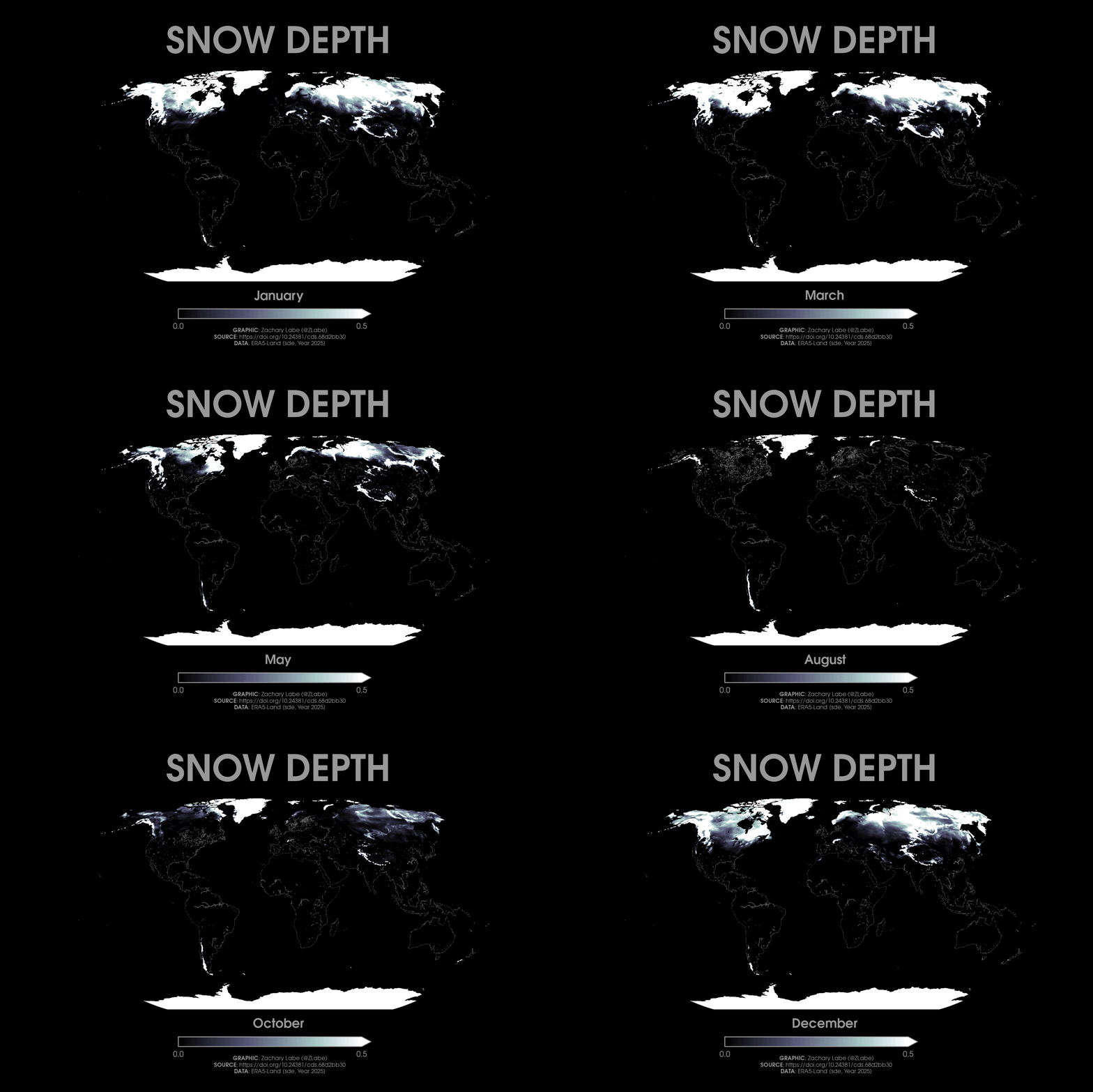
Hi all! Sorry for the delay in posting my first blog of the year. I’ve been spending a lot of time updating my visualizations with data through 2025 (and in some cases 2026). This means downloading and processing each dataset again and then manually updating the code and fine-tuning the figures. Maybe one of these years I’ll find a quicker way to roll everything into a new year… At this point, almost everything on my website should be up-to-date, aside from one or two remaining datasets needed for my reanalysis comparisons. If you notice any issues or typos, please let me know. I’m also in the process of adding alt text to my long-term visualizations (those updated monthly or yearly), which should help improve accessibility on these pages – thanks for your patience while I work through them.
With that said, here is a quick entry for January. As a reminder, these posts are always a bit lagged since I also summarize recent monthly conditions in the Arctic. I’m aiming to have the “February” post up by the end of this month.
My current entry features an animation showing monthly mean snow depth from the ERA5‑Land reanalysis during 2025 (January through December). This dataset is closely related to the standard ERA5 reanalysis produced by ECMWF, but it focuses specifically on land surface conditions at a higher spatial resolution of 0.1° by 0.1° (latitude by longitude) (~9 km). That finer grid helps better resolve coastlines, topography, and other important land surface characteristics. I’m using a sequential color scheme here (“bone” from matplotlib), with the scale saturating at 0.5 meters to emphasize variability at lower latitudes where snow depths are generally much smaller compared with places like the Greenland Ice Sheet and the Antarctic Ice Sheet. I also intentionally reduced the contrast for continents and coastlines, so the focus stays on the seasonal cycle of snowpack, particularly the differences between the Northern and Southern Hemispheres. There are also some interesting regions where snow persists year-round outside of the major ice sheets, though you can still see summer melt even across parts of western Greenland. Keep in mind that this shows monthly means, so it does not capture short-lived synoptic events where snowfall may have occurred for only a day or two.
I always enjoy visualizations that highlight the seasonality of meteorological and climatological variables, since so much can be explained by Earth’s axial tilt and the distribution of land versus ocean between the hemispheres. Snow cover plays an important role in the climate system because of its high albedo (reflectivity), meaning it reflects a large fraction of incoming sunlight back to space. Snow also strongly influences local weather and climate conditions, including boundary layer temperatures like through cold air damming events or nighttime radiational cooling. The amount of water stored in the snowpack (often measured as snow water equivalent) is critical for millions of people because it acts as a natural freshwater reservoir that feeds rivers used for drinking water and irrigation. It also supports ecosystems by influencing soil moisture, vegetation health, and the timing of plant growth.
However, human-caused climate change is reducing snow cover in many regions of the world. The largest declines occur during Northern Hemisphere spring, with substantial losses across Eurasia and North America by June as warmer temperatures lead to earlier melt. This reduction contributes to further Arctic amplification through the snow‑ice‑albedo feedback, where the loss of bright snow exposes darker land surfaces that absorb more sunlight. In mountainous regions, declining snowpack at higher elevations also reduces water availability later in the year and can leave landscapes drier and more susceptible to wildfire. Recent examples include the extreme warmth and early snowmelt that contributed to widespread wildfires across Siberia in 2020 and in Canada in 2023. Overall, understanding the seasonality, variability, and long-term trends in snow is an important part of monitoring changes across the climate system.
For January 2025, conditions across the Arctic featured unusually warm temperatures and very low sea ice, including low values for total extent, thickness, and volume. Some of the largest temperature anomalies occurred across eastern Siberia, the Canadian Arctic Archipelago, and the Barents Sea region. In fact, temperatures reached record-high levels across large portions of Greenland, especially along the western coast, with departures exceeding 5 °C above the 1981–2010 average. These conditions were partly linked to the large-scale atmospheric circulation, including a persistent blocking pattern and the associated phase of the N(AO). At the same time, temperatures were much colder than average across parts of western Alaska, western Siberia, and over Scandinavia. Sea ice has remained very low this winter, with numerous new daily record lows during the freeze season. The average sea-ice thickness near the North Pole also continues to reach record-low levels according to PIOMAS. The annual maximum sea-ice extent will likely occur soon, although it is still a bit early to predict its final ranking. That said, it will probably end up within the ten lowest maximum extents in the observational record.
Other Blogs (Monthly):
My visualizations:
The views presented here only reflect my own. These figures may be freely distributed (with credit). Information about the data can be found on my references page and methods page.